Key takeaways
- Source investigation and the room survey should begin with the observed discharge.
- The affected route may extend beyond the spot where sewage first appeared.
- Access restrictions should reflect actual contact and movement through the rooms.
- Absorbent materials need a specific retention or removal decision after sewage contact.
- Source correction, cleaning, drying, and finish repairs should have distinct status records.
Locate the discharge and investigate the source
The first report should identify where sewage appeared, which fixtures were involved and whether the discharge was continuing. A drain professional investigates the cause while the restoration team maps the surfaces contacted. Recording the time of each observation helps connect the drain findings with changes inside the room and shows whether additional material became affected before cleanup began.
The property contact should keep source findings separate from cleanup observations. A professional investigating the drain may answer a question that the room survey cannot, while the room survey documents surfaces beyond the fixture. Combining the findings is useful only when the record preserves who established each part of the account.
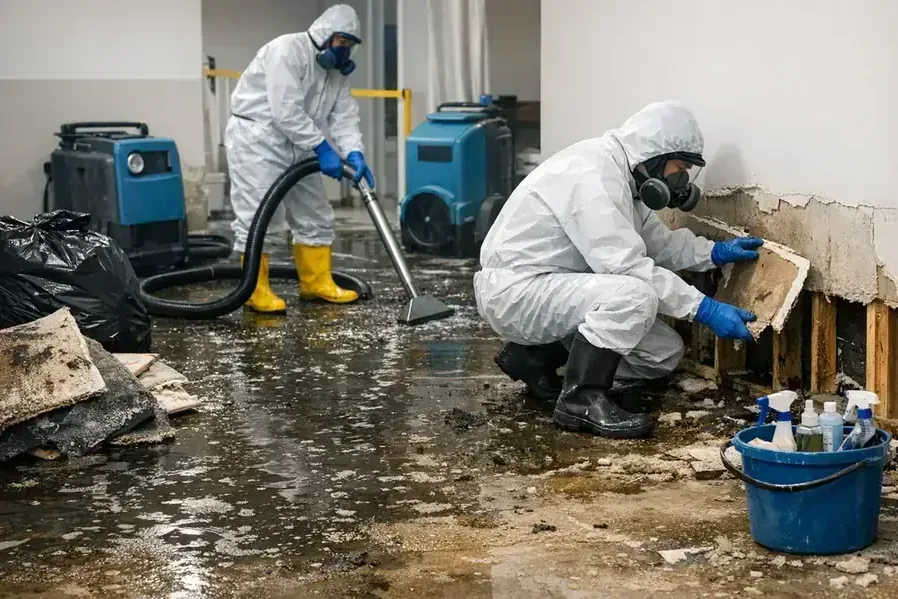
Cleanup planning starts with the discharge point and follows the wet path across the room. The crew notes contaminated finishes, nearby contents and a controlled route for removal. The same contact-based assessment guides sewage cleanup in Coopertown, with the rooms and materials listed separately for each property.
- Identify the first observed discharge point.
- Note whether entry was active or had stopped.
- Keep drain investigation findings with their source.
- Record the drain findings and the person responsible for repair.
Draw the affected boundary around contact and movement
The room where a backup first appears may not contain its entire footprint. Liquid can cross a threshold, reach storage, or contact the base of a partition. The survey should identify those connections and distinguish directly affected surfaces from neighboring areas whose condition still needs assessment.
Movement can also complicate the boundary. Belongings or tools carried out of an affected room should have a planned route and handling process. The work plan should not assume that everything outside the original doorway is unaffected if material has already moved through adjoining space without a record of its condition.
Occupants should remain outside the sewage affected area while access and handling are assessed. A clear restriction is more useful than a vague instruction to avoid the worst spot. The plan should identify the actual rooms or routes involved and update those limits when further inspection reveals a different extent.
- Show crossed thresholds on the room sketch.
- Identify contents already moved before assessment.
- Keep unrelated household traffic outside the work area.
- Revise the boundary when new contact is discovered.
Organize contents before cleaning opens more space
Furniture and stored items can obstruct the surfaces that need inspection, but moving everything into a shared pile creates another problem. The owner and provider should identify touched, untouched, and uncertain items so their histories remain clear. The purpose is to support handling decisions without spreading an unsupported damaged label to all belongings.
An item record should preserve its original room, observed contact, and planned destination. Specialty objects may require a separate assessment, while absorbent items need particular attention to whether they can be appropriately cleaned. The cleanup provider should avoid making valuation or recovery promises that the inspection cannot support.
Disposal decisions should identify the responsible authorization when circumstances allow. A photograph and a description of the affected item group make that decision easier to understand later. Those records also prevent an empty room after cleanup from concealing how much of the original work involved contents rather than the building itself.
Make material decisions before treating the room as dryable
Sewage contact changes the questions asked about a finish. A material that can lose moisture is not necessarily suitable to remain after that contact. The assessment should address its cleanability, condition, underlying layers, and access before a drying plan treats the assembly as something that will stay in the building.
Absorbent flooring, backing, and wall materials may require controlled removal where appropriate cleaning cannot be achieved. The record should identify the specific material and contact involved instead of applying an unexplained demolition rule to the entire room. Durable retained surfaces still need a cleaning decision before drying is treated as the remaining task.
The Coopertown water and sewage overview provides a separate service reference. Within this project, photographs of exposed layers should explain what the original finish concealed and why the chosen boundary changed, giving the owner a clear connection between observed contact and the material scope.
- Identify the layer that received sewage contact.
- Explain why a proposed retained material is suitable for cleaning.
- Record conditions beneath removed finishes.
- Keep unaffected material outside unsupported removal assumptions.
Protect the transition between the work area and clean space
The route used to remove affected material deserves as much planning as the room itself. Equipment, containers, and personnel may pass through a transition area repeatedly. That area should have a defined purpose so ordinary storage or household activity does not gradually occupy the space needed for controlled movement.
Cleaning tasks should account for tools and surfaces associated with that movement, not only the original floor. The provider should document the handling arrangement and any changes caused by expanding work. If an unexpected contact occurs outside the first boundary, it should trigger an assessment rather than be omitted because it lies beyond the initial sketch.
Affected space should not be reopened merely because visible liquid has been removed. The responsible provider needs to complete the relevant cleaning and material assessment before unrestricted use is considered. The owner should receive an explanation of what remains pending so a pause between tasks is not mistaken for a finished room.
Measure retained assemblies after the cleaning decisions
Once material removal and appropriate cleaning have been addressed, the retained assembly can be evaluated for drying. Monitoring locations should include accessible wall bases and floor transitions that belonged to the affected boundary. This ties the drying work to the actual material scope instead of treating the room as an undifferentiated open space.
An improving surface reading does not answer whether a concealed layer was cleaned or evaluated. The project record should therefore keep cleaning decisions and moisture measurements distinguishable. Both may be necessary to explain the retained material, and neither should be presented as a substitute for the other.
If further access reveals another affected layer, the plan should be revised before finishes are restored. The revision can state what was found, which decision changed, and which measurements need to continue. A clear change record is more useful than a final summary that leaves the reader unable to understand why the work expanded.
Hand over the source status alongside the room status
The drain investigation should establish what source work was completed and identify anything still unresolved. A room can be cleaned while the cause of recurring discharge remains under investigation. That distinction needs to be visible to the owner so the absence of standing water is not interpreted as proof that the underlying defect has been corrected.
Goodlettsville spans Davidson and Sumner counties, and the city provides separate permit instructions for work in those portions. The repair contact can use the property location when checking the applicable instructions. A clear cleanup report lists the openings and removed finishes so the next trade can plan its work.
Source repair, cleaning and drying should each have a clear status at handoff. The record lists rooms addressed, materials removed and contents awaiting a decision. For a property needing sewage backup cleanup in Coopertown, the same room-by-room record helps the owner coordinate the drain professional and the people replacing finishes.
Questions
Do Goodlettsville wastewater records prove who caused a backup?
They provide system context. Determining the cause of a specific discharge requires investigation of the incident and the plumbing or wastewater components involved.
Is the first overflowing fixture the whole cleanup area?
The discharge may have contacted adjoining surfaces or belongings after leaving that fixture. Inspection needs to establish the actual footprint rather than stop at the discovery point.
Can drying alone make a sewage affected finish suitable to keep?
Retention depends on the material, the sewage contact and whether thorough cleaning is practical. The crew assesses those conditions before deciding what can remain, then measures retained materials through drying.
What should remain separate in the handoff?
The drain repair status, contents disposition, cleaning work, moisture findings, and finish repairs should each be identifiable. That prevents completion of one task from implying that every part of recovery is finished.